app
Indexia
Turn documents into searchable, grounded answers.
Explore RAG workflows with transparent retrieval, citations, and verification.
Overview
About Indexia
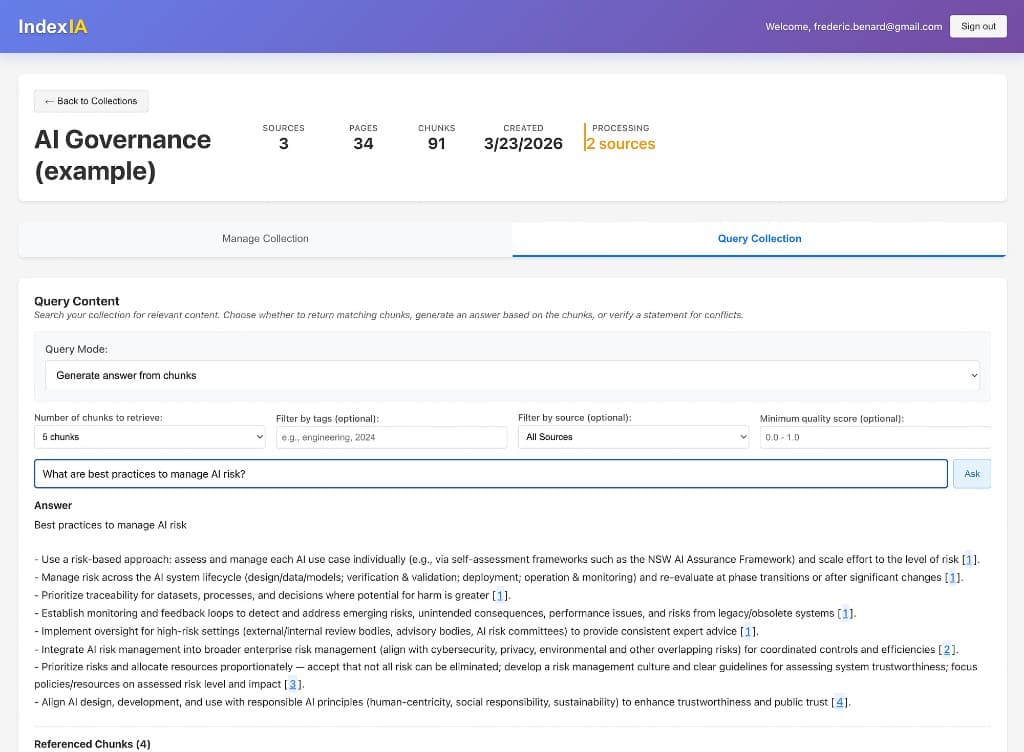
Indexia is an AI-powered knowledge indexing and retrieval application that helps you turn documents into searchable, grounded answers.
It was designed to make Retrieval-Augmented Generation (RAG) systems more transparent and accessible — not just as a black box, but as something you can explore, inspect, and understand.
From prototype to platform
Indexia originated as part of a simple RAG service built for projects like Allia, where the goal was to help organizations query internal knowledge more effectively.
As the system evolved, we extended it to:
- Support multiple document types (PDFs, web content, text)
- Use vision-language models (VLMs) to extract richer content from documents
- Expose intermediate steps of the pipeline (chunks, embeddings, retrieval)
The result is both a useful tool and an educational system for understanding how modern AI-powered search works.
What Indexia demonstrates
Indexia showcases the core building blocks of RAG systems, with visibility into each step:
- Document ingestion & extraction — parse PDFs and web content into structured text
- Chunking & embeddings — break documents into semantic units and store them in a vector database
- Semantic retrieval — use similarity search (e.g., cosine similarity) to find relevant content
- Grounded answer generation — generate responses backed by retrieved context
- Verification workflows — check whether a statement is supported by indexed sources
Why it matters
Many organizations struggle with:
- Fragmented knowledge across documents
- Slow access to reliable information
- Lack of transparency in AI-generated answers
Indexia explores a practical approach where:
- Answers are grounded in source material
- Retrieval is inspectable and debuggable
- Users can see how results are constructed
A MilaHub project
Indexia is part of MilaHub, a platform for showcasing applied AI systems and experiments.
It is designed to:
- Make RAG systems tangible and understandable
- Provide a practical tool for document exploration
- Bridge simple prototypes with more robust knowledge systems
Media